Most Langley homeowners we talk to assume that adding an EV charger automatically requires a 200A service upgrade. It doesn't. Many 100A homes can support a Level 2 charger without any upgrade at all. Whether yours can comes down to a load calculation, and the answer is often a pleasant surprise.
This guide explains how the calculation works, what pushes you over the edge, and the cheaper alternatives when a full upgrade isn't viable.
The fast answer
If you have 100A service and your home is mostly gas-heated (gas furnace, gas water heater, gas range), you can almost certainly add a 32A or 40A Level 2 charger without a service upgrade. We see this every week in older Walnut Grove and Murrayville homes.
If you have 100A service and your home is all-electric (electric heat pump, electric range, electric water heater) — or you're planning to add any of those — a 200A upgrade is usually required.
If you have 200A service already, you're fine for any size EV charger plus most other modern appliances.
How residential load calculation actually works
The BC Electrical Code Section 8 lays out the formula. It's not a vibes-based decision — it's math. Here's the simplified version we run:
Step 1: Sum the loads
- Basic dwelling load (depends on square footage)
- Largest of: electric heating OR air conditioning (not both — code allows the larger one only)
- Cooking equipment (electric range or cooktop)
- Electric water heater (if present)
- Dryer (if electric)
- Any other 1500W+ load (heat pump, hot tub, sauna, etc.)
- EV charger circuit (40A or 50A new addition)
Step 2: Apply the demand factors
- First 10 kW of the basic load at 100%
- Remaining basic load at 40% (yes, the math discounts diversity)
- Heating/cooling at 100% (no discount, can't run them at the same time as everything else, but code says full load)
- Other electric loads with various demand factors
Step 3: Divide by 240V to get amps
- Result must be less than your service amperage
- For 100A service: must be under 100A
- For 200A service: must be under 200A
Step 4: Add safety margin
- We don't quote work that puts a panel above 80% capacity, even if it technically passes code
- That margin protects you from nuisance breaker trips during peak loads
When 100A is enough
In our experience across hundreds of Langley EV charger installs, 100A service supports a Level 2 EV charger in these common scenarios:
- Gas furnace + gas water heater + gas range + 32A EV charger ✓
- Electric baseboard heat (small home <1,200 sq ft) + gas range + 32A EV charger ✓
- Heat pump + gas water heater + gas range + 32A EV charger ✓ (sometimes — depends on heat pump size)
- 1980s home with gas appliances + 40A EV charger ✓
When 200A is required
We've seen these combinations push 100A over the edge:
- Electric heat pump + electric water heater + electric range + 50A EV charger ✗
- Electric baseboard (large home) + electric range + 40A EV charger ✗
- Existing hot tub + EV charger + electric appliances ✗
- Future-proofing for full electrification (the smart move if you'd planning to add a heat pump in 2-3 years)
If you're in this group, the 100A to 200A service upgrade typically runs $3,800 to $6,500 in Langley, BC Hydro coordinates the disconnect, and the work is a single-day job.
Three options when 100A is tight
If the load calc comes back close to or over 100A, you have three options before defaulting to a full service upgrade:
Option 1: Smaller charger
A 32A charger (40A breaker) draws less than a 48A charger (60A breaker). For most EVs, 32A still gives you 5 to 8 hours of full charge overnight, which is fine for daily commuting. The Tesla mobile connector with a NEMA 14-50 outlet at 32A is the simplest version of this.
Option 2: Load-management device
Devices like the DCC-9 (Black Box) or NeoCharge let you share a circuit between two appliances. The classic use case: share the EV charger circuit with the dryer. The device monitors current draw and pauses one appliance when the other ramps up. Code-compliant, costs $400 plus install, saves $3,500+ vs a service upgrade.
Option 3: Tandem breakers and panel reorganization
Sometimes a 100A panel is "full" because the breakers are inefficiently arranged, not because the service is maxed. A panel reorganization with tandem breakers (where allowed) can free up the slot for an EV charger circuit. We do this on older panels where it's mechanically possible. Cost: $400 to $700.
When the upgrade is the right move anyway
Even if your 100A panel can technically support an EV charger today, the upgrade to 200A makes sense if:
- You're planning to add a heat pump within 2-3 years (CleanBC rebate timeline)
- You're planning to add an electric range or water heater
- You want to add a second EV charger for a future second car
- Your panel is older than 30 years and could use replacement anyway
- You're already doing major renovations (drywall open, easier to reroute)
In those cases, doing the upgrade now means one permit, one BC Hydro coordination, one disconnect instead of multiple visits later. We bundle service upgrades with EV charger installs all the time.
How to find out for sure
Send us a few photos:
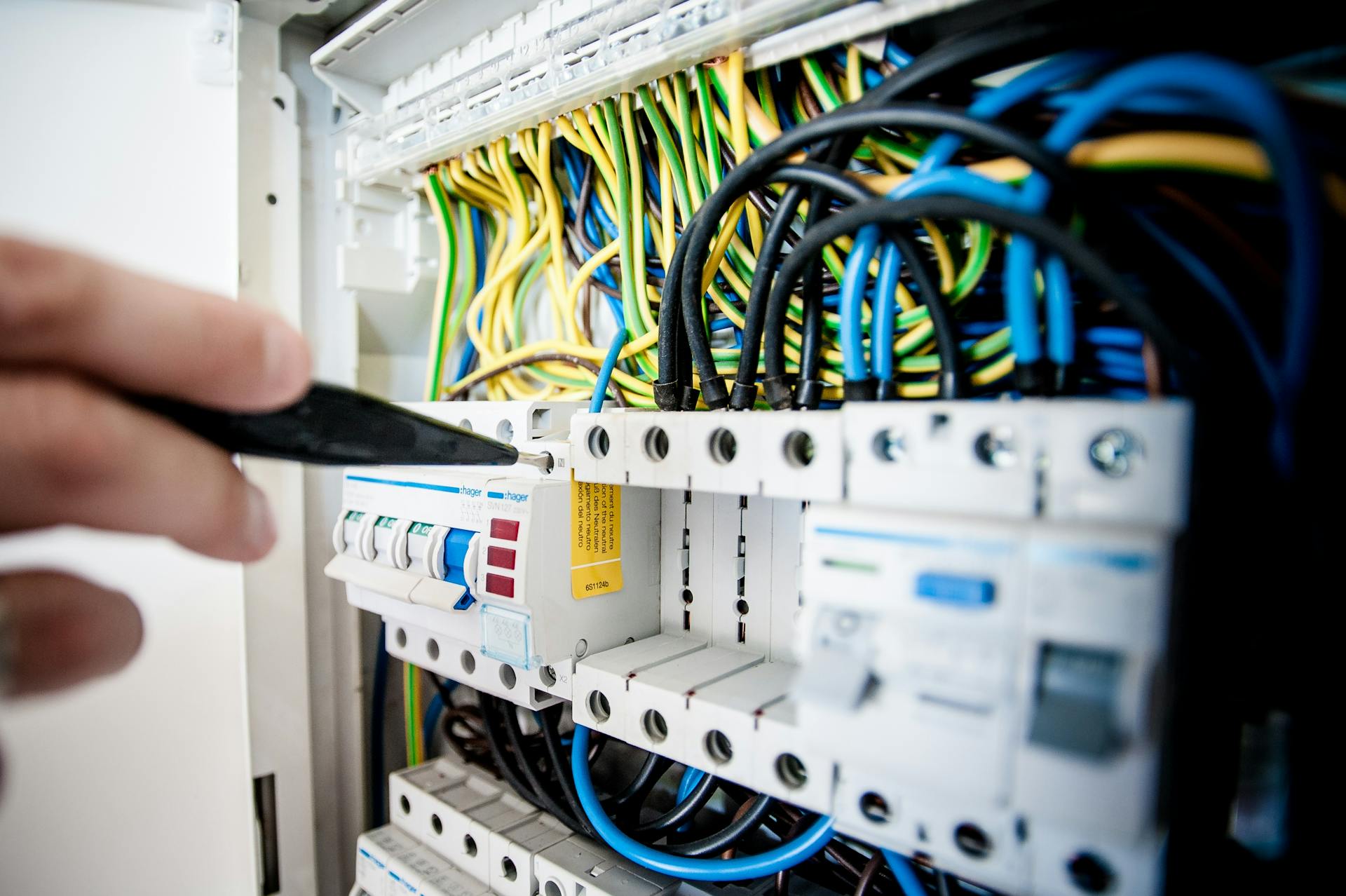
- Your main breaker (usually labeled with the amperage)
- The full panel with the door open so we can count breakers
- Notes on what's electric (heat, range, water heater, dryer, hot tub)
We'll run the load calculation and tell you within 24 hours whether you need an upgrade or whether your existing service is fine. No charge, no commitment.
Call (236) 862-1196 or send your project details and panel photos. If you'd rather schedule a 30-minute site visit, we can do that too — we cover Langley, Surrey, Abbotsford, and the rest of Fraser Valley.
Frequently asked
- Look at the main breaker at the top of your panel. The number on the handle is your service amperage. Common sizes in Langley are 60A (older homes pre-1970), 100A (1970s to 1990s), 150A (rare), and 200A (most homes built after 2000).
- BC Electrical Code Section 8 specifies the calculation. Roughly: take the larger of (basic load + heating + AC) or (basic load + cooking + dryer + EV charger + 25% of remaining loads). The actual calc is more nuanced, which is why an electrician runs it. The result is in amps, and it must be less than your service capacity (100A or 200A).
- Yes. A 32A charger draws 40A continuous on a 40A breaker, vs a 48A charger which needs a 60A breaker. The difference can be the line between 'fits' and 'service upgrade required.' We default to 32A on tight panels.
- Devices like the DCC-9 or NeoCharge let you share a circuit between two appliances (like an EV charger and a dryer). They're code-compliant and can avoid a service upgrade. Cost is around $400 plus install. We use them when a 200A upgrade isn't viable.
- If you have 100A service with no electric heat, no electric range, and no heat pump, you can usually add a 32A or 40A EV charger without an upgrade. Add electric heat or a heat pump on top of that, and 200A becomes likely. We confirm with a load calculation before quoting.